How long should a client gallery stay live?
Every photographer has a gallery expiry policy. Almost nobody chose it on purpose.
Most were set by a default in a piece of software, or by a decision made once in a hurry three years ago, or by never deciding at all — which is itself a policy, and usually the most expensive one. It is worth ten minutes of actual thought, because the window you pick quietly determines your storage bill, your inbox volume, and how often a past client is reminded that you exist.
Both directions cost you something
Too short and you are fielding dead-link emails — frequently from the exact person who was about to book you again. The couple whose gallery expired at 30 days is not annoyed at the policy; they are annoyed at you, and the anniversary they were about to celebrate by ordering an album is now a support ticket. Short windows also punish precisely the clients you most want: the ones who share widely, come back for newborn sessions, and refer their friends.
Too long and you are quietly paying to warehouse galleries nobody has opened in three years. Storage accrues in a way that is invisible month to month and obvious annually. Worse, an indefinite window means every gallery you have ever delivered is still live, still shareable, and still your responsibility — including the ones for clients whose circumstances have changed in ways that make a permanently public link a genuine problem.
Neither failure announces itself. You discover the first through complaints and the second through an invoice.
A default that works
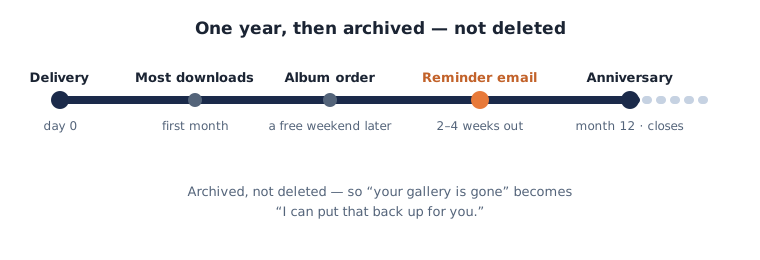
For most portrait and wedding photographers: one year of full access, then archived rather than deleted.
A year covers the whole natural life of the job. The initial download in week one, the parents who take a month to get to it, the album order that happens when the couple finally has a weekend free, and the anniversary — which is the single most reliable re-engagement moment in this business, and which a 90-day window structurally cannot capture.
Then archive rather than delete. Archived means the gallery comes down from active delivery but the files are not destroyed, and reactivating is a request you can say yes to — for a fee, or as a gesture, your call. This converts the worst conversation in the category ("your gallery is gone") into an ordinary one ("I can put that back up for you"). It also means the expiry decision is no longer irreversible, which is what makes it comfortable to enforce.
Adjust from there rather than starting somewhere else:
- Event and volume work — school sports, dance, race days, conferences — runs much shorter. 60 to 90 days is normal, purchase intent collapses quickly after the event, and the volume makes indefinite retention genuinely expensive.
- Commercial and brand work is usually governed by the contract, not by a default — licence terms and usage windows decide it, and the gallery should match whatever you signed.
- Weddings are the strongest case for a long window, and the best case for archive-not-delete. The anniversary is real revenue.
Say it three times, in writing
Whatever you choose, the policy only works if the client knows it — and told once, at delivery, is told zero times.
- In the contract. Where it is unambiguous and where it protects you.
- In the delivery email. The email that contains the link is the email people actually read. State the proofing and download window in one sentence: *your gallery is available until [date] — please download your full-resolution images before then.* A specific date outperforms a duration, because "one year" requires arithmetic and a date does not.
- On the gallery itself. Visible on the page, so the person who forwarded the link to twelve relatives has not accidentally made a promise you are not keeping.
A policy that is enforced but never communicated reads as a platform failure. The same policy, stated three times, reads as professional operating procedure — and nobody has ever been annoyed by that.
The one email worth sending
Here is the part most photographers never build, and it is the reason to care about expiry beyond the storage bill.
Send a reminder before the gallery closes. Two to four weeks out, one short email: your gallery closes on [date], here is the link, download anything you have not yet.
That single message does four things at once. It rescues the client who genuinely forgot. It prevents the dead-link complaint entirely. It is a legitimate, welcome, non-salesy reason to appear in the inbox of someone who already likes your work. And it produces a reliable, small bump in late album and print orders — because a deadline is the only thing that has ever moved a project from "we should do that" to "we did that".
If you send exactly one automated email in your entire business, send this one. It has a better return than almost anything else you can automate, and the reason is not clever marketing: it is that a real deadline attached to something people actually care about is the most effective prompt in existence.
Make it a decision
The specific window matters much less than the fact that you chose it. Thirty days, ninety, a year, forever with an archive step — each is defensible for some kind of work. What is not defensible is a policy set by a software default that you have never looked at, enforced on clients who were never told, and paid for on a line item you have not read.
Pick a window. Write it down in three places. Send the reminder email.
Then check what it does to your storage — because retention is the biggest single lever on how much storage you need, and while you are auditing what lives where, remember that a gallery is not an archive.
Tobren Deliver lets each studio set its own gallery expiry rather than inheriting a platform default. More articles.